


We asked the staff at the MIT Press Bookstore for some recent book recommendations. Head over to 314 Main St., Kendall Square, to continue the conversation.
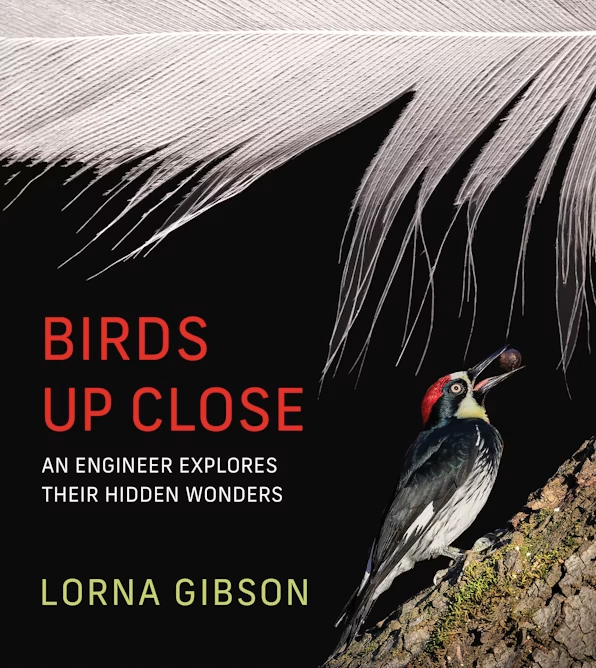
“Birds Up Close: An Engineer Explores Their Hidden Wonders,” by Lorna Gibson. MIT Press, 2026.
How do birds fly? Why do some feathers look blue when they don’t have blue pigment? In seven accessible, gorgeously illustrated chapters focusing on feathers, flight, bills, and eggs, Gibson, a professor of materials science and engineering at MIT and a lifelong birder, gets deep into how birds work. I can’t think of anyone who wouldn’t be intrigued, informed, and delighted by this book, but it’s particularly perfect for birdwatchers and the scientifically curious. — recommended by Rebecca

“The Butch Manual,” by Clark Henley. Dark Entries Editions, reprinted in 2025.
First published in 1982, Henley’s tongue-in-cheek, affectionate guide to all things butch is finally back in print. The reader is guided through a quiz to gauge their own butch levels, then instructed in important pointers like how to chew gum while leaning against a wall, what expressions to use (“Smiles are considered socially acceptable on babies”), and how to get your 501 jeans extra-tight by wearing them in a bathtub full of hot water, fabric softener, and Ajax. This is more than a cultural artifact: It’s history, and it is very, very fun. Er, I mean very, very butch. — recommended by Rebecca

“Spam: A Global History,” by Kelly A. Spring. Reaktion Books Ltd.
“Spam is a law unto itself,” Spring begins. “It is hard to define, and for many, even harder to fathom consuming.” Whether you love or loathe the tinned pork, Spring will help you understand it: how it started as a way to cheaply and efficiently feed the masses during the Depression, how it was marketed and lampooned, and how it became a part of global cuisine. Concluding with a helpful selection of recipes, this book might tempt you to give Spam another taste. — recommended by Rebecca
“Land of the Lustrous,” by Haruko Ichikawa. (13 volumes). Kodansha Comics.
Many years ago (so many years ago that the number means nothing), six meteors collided with the earth, shaving off six new moons and plunging the planet’s surface into chaos. Once the dust settled, new genderless lifeforms arose on the land: beautiful gemstone people who feed on sunlight and live forever. These gems must defend their small society from a perpetual onslaught of Lunarians, moon people who come to the planet in order to kidnap the gems and use their parts for jewelry back home.

Or at least, that’s how the story goes.
But, once the enthusiastic yet brittle Phosphophyllite is tasked with compiling the gems’ first encyclopedia, they discover things about their world and their fellow gems that they never could have imagined. How much of the old story is true? And how much of Phos will remain when everything from the Lunarians to social pressure seem bent on breaking the young gem apart?
As you’ve certainly guessed from that summary, Land of the Lustrous is a delightfully strange little series. The world building goes hard, and any plot point that initially seems off or purely aesthetic eventually reveals a deeper meaning. I particularly enjoy how human gender markers and relationship dynamics get recycled and remixed in this world where our own biology and social structures are nothing but a distant memory.
Fittingly for its subject matter, this manga’s art is beautiful. Haruko Ichikawa has a strong sense of composition and design as well as an exacting eye for detail. The light as it plays through the petrified “hair” of a gem. The delicate embroidery on the inside of a romper.
Nothing is missed.
Even so, the true beauty of this manga lies in its characters. I can’t help but root for this strange little family even and especially when they do things that are disappointing, foolhardy or cruel. Each character’s arc has a lot to say about the way that pain and pressure can harden people or grind them into dust. Sometimes, both things happen at once.
Start for the bizarre premise and pretty art. Stay for the sharp character studies and the gentle melancholy of impermanence on the geological scale. The thirteenth and final English-language volume dropped recently, making this the perfect time to hop onboard. — Recommended by: Rae
“Rocks: A Guide to the Stones Around Us and the Stories They Tell” By Vojta Hybl. Frances Lincoln

“Rocks” is not a field guide in the common sense. Instead, illustrator and author Vojta Hybl has given us a window into the lives of rocks by encouraging the reader to slow down an appreciate the long journey that each and every stone took to become what it is today.
Hybl’s art breathes new life into old faithfuls like marble, chalk, or pumice, but also introduces the reader to new friends like phonolite, a rock that makes a bell-like sound when you hit it, or komatiite, an “extinct rock” that no longer forms on this planet because earth’s magma just isn’t as hot as it used to be. I was especially intrigued by the section on anthropic rocks, rocks that form in response to human activity. The green and glassy trinitite, for example, first appeared in the universe after the Trinity nuclear test cooked the New Mexico sand. Hybl’s decision to use illustrations instead of photos really shines in this section. After all, some of these trace fossils of humanity won’t exist for another couple million years!
Hybl asks readers to “embrace rocks as our kin.” I can’t imagine a better invitation than this lovely book. — Recommended by: Rae
“A Little Queer Natural History” by Josh L. Davis. University of Chicago Press.
I love a good, big-budget nature documentary. If we could find a way to keep David Attenborough alive and happy for another 150 years, I would give financially irresponsible amounts of money to make it happen. At the same time, I sometimes get tired of how frequently nature documentaries trot out the same handful of stories, especially when the natural world can get incredibly, delightfully strange.

A Little Queer Natural History introduces some welcome variety into the dreary, imposed normalcy of so many narratives about the natural world. Josh Davis educates his readers on classic “gay” animals like bonobos and the various species of all-female whiptail lizards that still manage to lay fertile eggs. For me, however, the book shines much brighter when it brings in the deeper cuts, like the bicolor parrotfish, one of the about 90 species of parrotfish that undergo a spontaneous change in sex once they reach a certain size. Even further afield we have the common wood louse, whose sex is determined by bacterial infection, or the split gill mushroom, which has thousands of mating types. Not all of the examples in Davis’s book map neatly onto human identities, and I think that’s half the fun. As much as I appreciate seeing myself in the natural world, I also love to be blindsided by its mystery and complexity. There are more ways to be alive than most people realize, and the world is more interesting if you stay curious.
Davis, in addition to facts about the natural world, also provides welcome historical context for how the scientific community and the world at large have dealt with these discoveries. I was particularly interested in the book’s treatment on male penguin couples. Of course, queer penguins are not new. We have children’s books about them. Odds are that when I mention “gay nature,” the penguins are one of the first examples a lay audience would think of. Still, gay penguins are much older news than I thought. In 1911, ship surgeon and zoologist Dr. George Murray Levick landed at Cape Adare and witnessed an entire Adélie penguin breeding season. His observations, which sometimes confused him so badly that he wrote them in a Greek cypher instead of English, included multiple instances of penguin homosexuality. When Levick later published his findings, the sections on these “hooligan” penguins did not make it to the final publication. Instead, these sections were passed around by a small handful of scientists who were allowed to know about them. The full report was only published in 2012, after someone found a copy of this top-secret penguin pamphlet tucked away inside another book.
It can be difficult to know whether or not it makes sense to use our human terminology to describe the behavior, much less identity of non-human animals. Even within our own species, cultural labels can’t always apply evenly in every time and place. But it is still nice to remember that, even when we feel most out of place, the world is big and weird enough for all of us. Happy Pride! — Recommended by: Rae
A stronger

Please consider making a financial contribution to maintain, expand and improve Cambridge Day.
We are now a 501(c)(3) nonprofit and all donations are tax deductible.
Please consider a recurring contribution.