


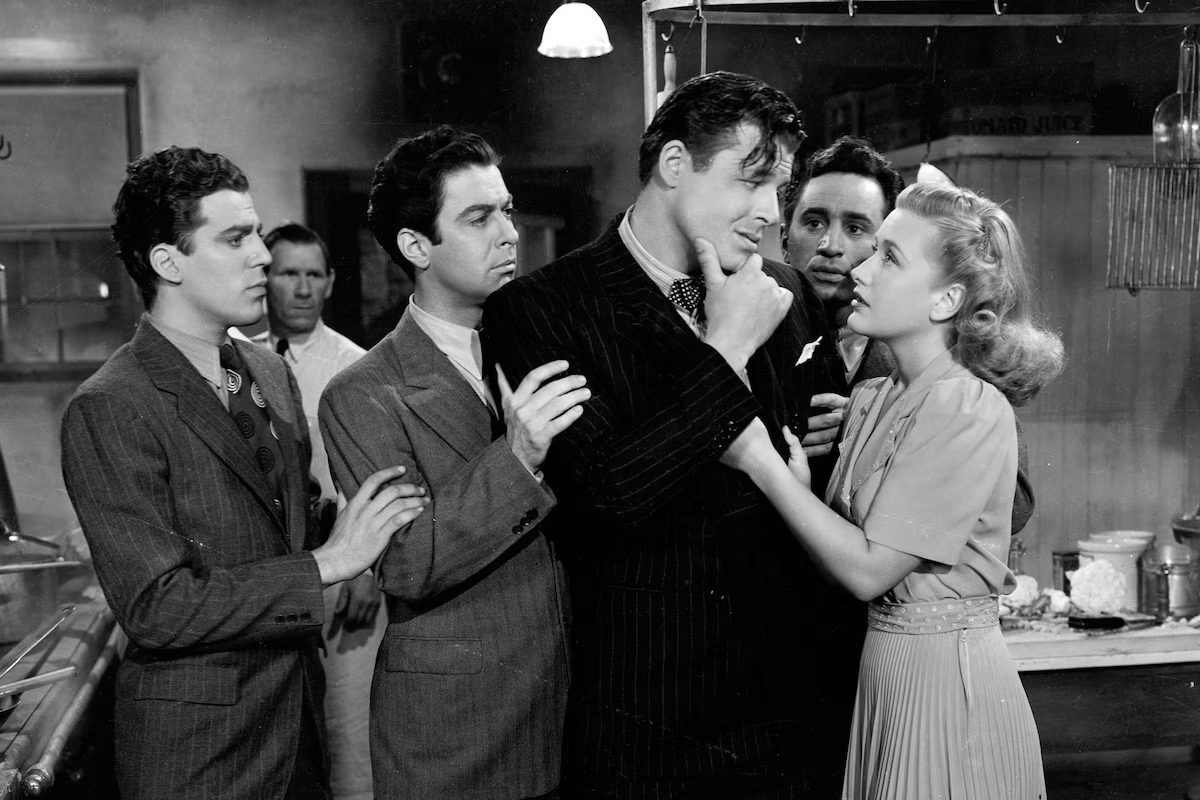
If someone asked you to picture a film noir, you’d probably conjure a handful of visual signifiers: a sultry femme fatale, a hard-drinking gumshoe in a fedora, shadows darker than the human soul. But what would it sound like? Chances are you can already hear a low, bluesy saxophone, possibly accompanied by lightly brushed drums and a slinky vibraphone. It is this intersection of film noir and jazz that lies at the heart of this year’s Noir City Boston, the Brattle Theatre’s annual collaboration with the Film Noir Foundation. From Friday through Monday, the Brattle screens nearly a dozen features that marry the coolest of cinematic and musical genres, almost all introduced by author and FNF director Foster Hirsch.
Some of these titles will likely be familiar, such as the double feature of “Gilda” (1946) and “To Have and Have Not” (1945) on Saturday, which respectively star Rita Hayworth and Lauren Bacall as morally dubious chanteuses. Some of the series’s most intriguing selections, however, might fly under the radar. Anatole Litvak’s “Blues in the Night” (1941), which opens the series Friday in a double feature with “Black Angel” (1946), is widely considered the inaugural jazz noir, a mile-a-minute thriller about a jazz combo (whose members include a pre-fame Elia Kazan!) and their descent into depravity. Equally remarkable is Basil Dearden’s “All Night Long” (1962), a sort of swingin’ 60s update of “Othello,” starring Patrick McGoohan as a scheming jazz drummer Iago, as well as a constantly jamming band of rotating musicians, including jazz legends Charles Mingus and Dave Brubeck; it screens Saturday in a double feature with the Duke Ellington-scored “Anatomy of a Murder” (1959). It all leads to Monday’s finale of the great “Sweet Smell of Success” (1957), starring Tony Curtis as unscrupulous publicist Sidney Falco and a terrifying Burt Lancaster as ruthless gossip columnist J.J. Hunsecker. For the complete series lineup and ticket information, check out the Brattle’s website.
On Saturday, the Somerville Theatre‘s ongoing tribute to Kurt Russell and Jodie Foster continues with a double feature of two of the actors’ most celebrated — and chilling — works. Foster won her second Oscar for her role as Clarice Starling in Jonathan Demme’s horror classic “The Silence of the Lambs” (1991), a hero strong enough to hold her own against one of cinema’s all-time great villains, Anthony Hopkins’ Dr. Hannibal Lecter. Remarkably for such a roundly perverse film filled with cannibalism and brutality, “Silence” was a cultural phenomenon. The same could not be said for John Carpenter’s “The Thing” (1982), which was shrugged off upon its release but is now revered as one of the genre’s finest moments. Russell plays the rugged helicopter pilot R.J. MacReady, who must outwit the malevolent, shape-shifting alien entity inhabiting the researchers in a remote Antarctic outpost. Both films have retained their full power to shock in the decades since their release, and they remain two of Russell and Foster’s finest hours.

Also on Saturday, the Somerville’s weekly Midnight Specials series celebrates the 40th anniversary of one of the most explosive and influential arthouse hits of the 80s. In David Lynch’s “Blue Velvet” (1986), Kyle MacLachlan plays a clean-cut, all-American college kid who gets in way, way over his head after discovering a severed ear lying in a field in his hometown. His Hardy Boys attempt to solve the murder gets him entangled with town sociopath Frank Booth (Dennis Hopper) and sadomasochistic lounge singer Dorothy Vallens (Isabella Rossellini). This was Lynch’s fourth film (following “Eraserhead,” “The Elephant Man,” and “Dune”), but it’s the one that cemented the distinctly Lynchian vision of small-town America, which would eventually bring him to “Twin Peaks.” It also marks his first work with several key collaborators, including actress Laura Dern, composer Angelo Badalamenti, and singer Julee Cruise. If you’re looking for a gateway to the wild world of Lynch, you could do worse than through that infamous ear canal.
On Sunday, organist Jeff Rapsis returns to the Somerville with another improvised live score to a silent cinema classic. This time around, the subject is Lotte Reininger’s “The Adventures of Prince Achmed” (1926), one of the most fascinating and oft-overlooked films of the era. Contrary to the Disney party line, “Achmed” is the earliest known surviving animated feature film. Inspired by the German tradition of silhouette artwork and the Chinese art of shadow puppetry, Reininger used paper cutouts pressed under a thin sheet of lead to create eye-popping monochrome images, which she then hand-tinted with various colors. The film, a loose fantasia on elements from the “One Thousand and One Nights,” is like very little else made before or since. Seeing it in a crowd of moviegoers in the Somerville’s ornate main house, accompanied by one of Rapsis’s signature improvised scores, sounds nothing short of magical.
On Thursday, the Somerville Theatre’s Thirsty Thursdays series returns with one of the toughest watering holes ever committed to screen. Robert Rodriguez’s “From Dusk Till Dawn” (1996) follows bank robber brothers Seth and Richie Gecko (George Clooney and Quentin Tarantino, the latter of whom wrote the screenplay) as they flee the authorities across the border. On instruction from their Mexican contact (Cheech Marin, in one of three roles), the Gecko brothers hole up in a seedy biker bar called the Titty Twister. And then … on the off chance that you haven’t seen it, I won’t spoil the plot twist that occurs at the film’s halfway point, but suffice to say the FBI quickly becomes the least of the brothers’ problems. What I will say is that the atmosphere inside the bar is one of the most dizzying works of pulp fiction in either Tarantino’s or Rodriguez’s filmographies, with scene-stealing performances from Danny Trejo and Salma Hayek and a killer soundtrack from Chicano psychobilly band Tito & Tarantula. It’s one of the giddiest genre films of the 90s, and the equivalent of a truly wild night out on the town.
A stronger

Please consider making a financial contribution to maintain, expand and improve Cambridge Day.
We are now a 501(c)(3) nonprofit and all donations are tax deductible.
Please consider a recurring contribution.