


Even among the rich, eerie world of Japanese horror cinema, Kiyoshi Kurosawa stands alone. His films mix traditional Japanese forces and spirits with the more mundane horrors of the modern world (Kurosawa’s most recent feature, last year’s “Cloud,” is a morality tale about a crooked eBay reseller). In celebration of the release of Kurosawa’s new short film “Chime” (2024), about a culinary master driven to insanity by an insistent tone repeating inside his head, the Brattle Theatre has curated a mini-retrospective titled Kiyoshi Kurosawa x4. The 45-minute “Chime” screens Friday through Sunday in a double bill with a new 4k restoration of “Serpent’s Path” (1998), a dark gangland revenge picture starring Shō Aikawa. Also screening, on Saturday and Sunday, is the rarely seen “Spider’s Eyes” (1998), which Kurosawa shot concurrently as a sort of companion piece to “Serpent’s Path,” taking the same basic presence (as well as Aikawa) in a much different direction. The series is rounded out Friday and Saturday by arguably Kurosawa’s most famous work, the chilling “Cure” (1997), which rivals “Se7en” in terms of sheer serial killer bleakness. The four films on display here make a perfect entry point to Kurosawa’s dark, disturbing world.
On Sunday, the Somerville Theatre kicks off its latest artfully curated repertory series by looking at Kurt & Jodie — that is, Kurt Russell and Jodie Foster. The two onetime Disney child stars matured into respected actors, and the Somerville has programmed a dozen double features capturing Russell and Foster at similar points in their careers. The series begins on Sunday with the two actors in their Disney era: Foster in her breakout role in the original “Freaky Friday” (1976) and Russell in the delightfully doofy sci-fi comedy “The Computer Wore Tennis Shoes” (1969). On Monday, the series jumps to the roles which respectively brought the pair their first tastes of more sophisticated acclaim: Foster as teenage sex worker Iris in Martin Scorsese’s “Taxi Driver” (1976 — the same year as “Freaky Friday”) and Russell as post-apocalyptic antihero Snake Plissken in John Carpenter’s “Escape from New York” (1981). The series continues into July, with double features of canon classics and relative obscurities alike.
Also on Sunday, the good folks at RPM Fest return to the Brattle, showcasing yet another fascinating experimental filmmaker. The subject of this month’s program is writer and filmmaker Brian L. Frye, whose work, per RPM’s website, “explores the relationships between history, society, and cinema through archival and amateur images.” The program, simply titled “America,” collects eight of Frye’s 16mm shorts, followed by a live Q&A between the filmmaker and RPM’s Brett Melican. Some of the most fascinating cinema right now is being made far from Hollywood — and we are lucky to live in a city where we can see it on the big screen.
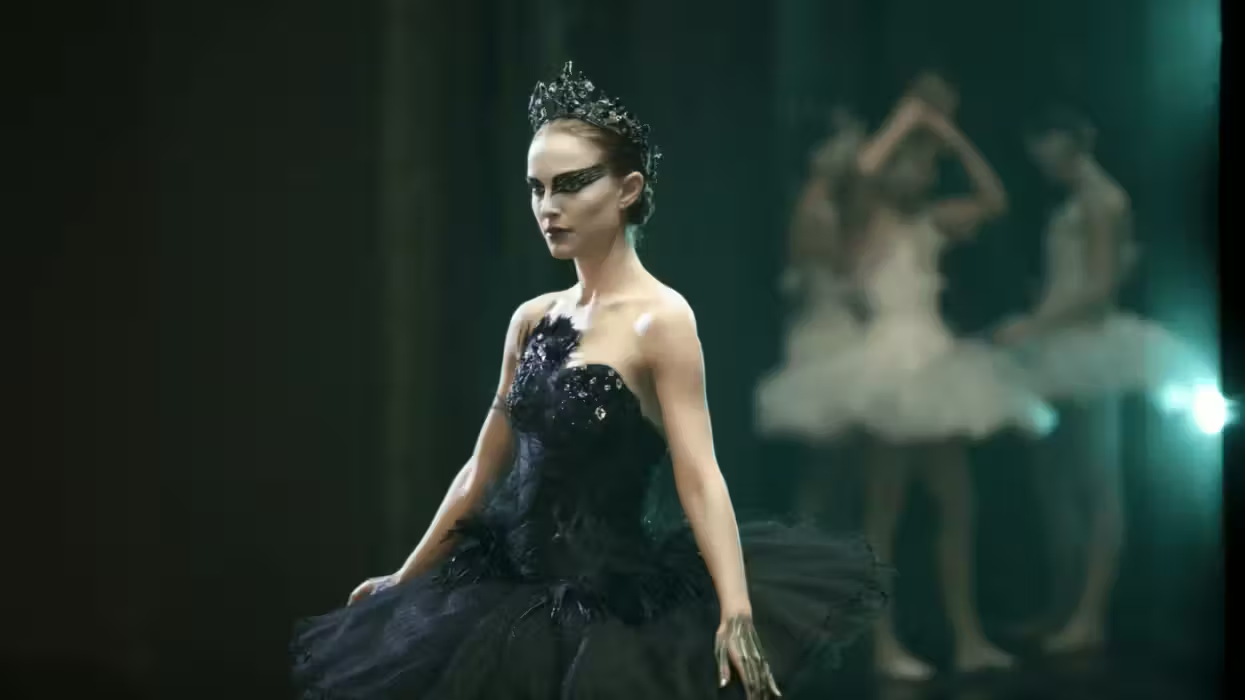
Ever feel like you’re not quite yourself — or that someone else might be? On Monday, the Brattle kicks off a short repertory series titled Another You: Doppelgangers, Doubles, and Dupes in Cinema, co-presented by the American Repertory Theater’s production of “Black Swan.” Darren Aronofsky’s original “Black Swan” (2010) is, of course, included, screening on Thursday in a double bill with Krzysztof Kieślowski’s similarly slippery “The Double Life of Véronique” (1991). Also on the docket are Monday’s double feature of two arthouse monoliths, Ingmar Bergman’s “Persona” (1966) and David Lynch’s “Mulholland Drive” (2001); Susan Seidelman’s delightful “Desperately Seeking Susan” (1985) on Tuesday, in which a repressed Rosanna Arquette swaps places with a free-spirited Madonna; and, on Wednesday, a pair of heady science fiction classics, Andrei Tarkovsky’s “Solaris” (1972) and Alex Garland’s “Annihilation” (2018). It’s enough to make you double check all your multi-factor authentication as soon as you get home — you know, just in case.
On Wednesday, the Somerville Ciné-Club continues its month-long tribute to Charlie Chaplin with an unusual double feature at the Somerville Public Library (Central Branch). Chaplin’s 46-minute classic “The Pilgrim” (1923) marked the actor-filmmaker’s transition from short subjects to features. It’s paired with a true obscurity: the 1922 short “Don’t Be Foolish,” starring noted Chaplin impersonator Billy West. To make the evening even more unique, both films will screen on vintage 8mm prints, with newly recorded original scores by local musicians (Travels With Bindle for “The Pilgrim” and Jevin Kames for “Don’t Be Foolish”). Ciné-Club admission is always free, and attendees are encouraged to stick around after the show to discuss the films with fellow local cinephiles.
A stronger

Please consider making a financial contribution to maintain, expand and improve Cambridge Day.
We are now a 501(c)(3) nonprofit and all donations are tax deductible.
Please consider a recurring contribution.